Apex Multispeciality Hospital : Kopar Khairane
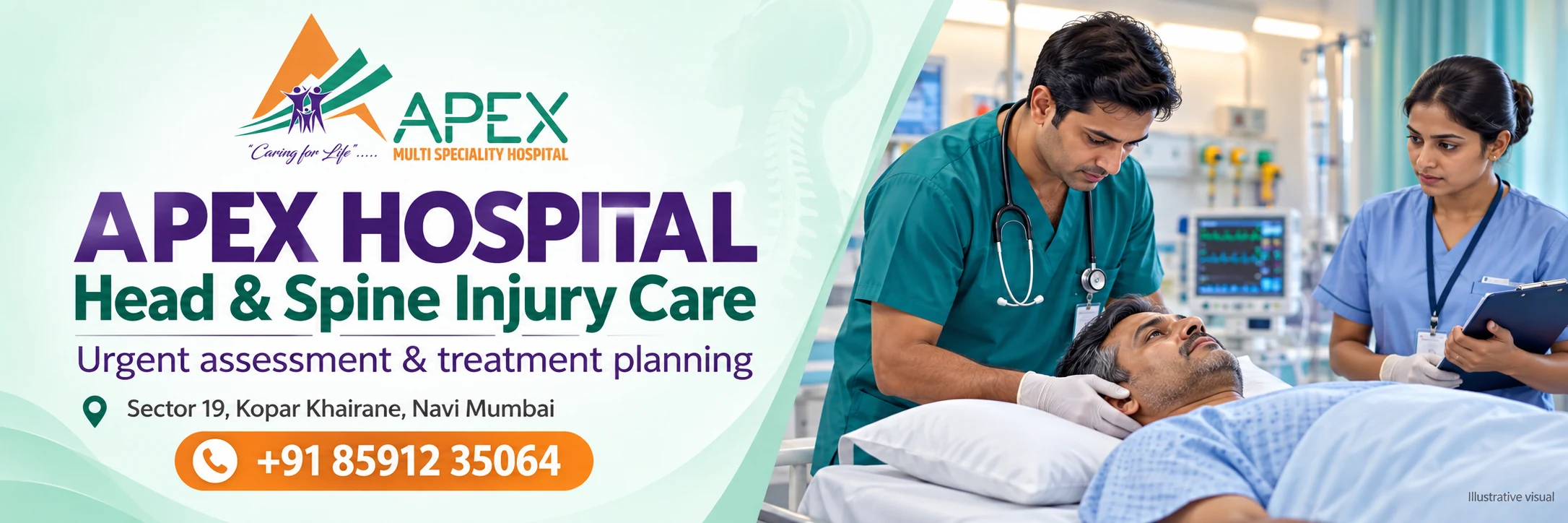
Head & Spine Injury Treatment in Kopar Khairane, Navi Mumbai
Head and spine injuries from road accidents, falls and assaults range from mild concussion to life-threatening bleeding in the brain or damage to the spinal cord. Apex Multispeciality Hospital, Kopar Khairane, treats head and spine injuries 24/7 through its emergency department, with neurosurgeons for emergency surgery and ICU monitoring.
After a head injury, go to emergency immediately if the person was knocked out, is drowsy or confused, vomits more than once, has a fit, has clear fluid or blood from the nose or ears, has a worsening headache, or has weakness or numbness. If a neck injury is possible, do not move them. Call +91 85912 35064 or 108, or come to the 24/7 Emergency department. |
Types of head injury
- Concussion: a mild brain injury causing headache, dizziness or brief confusion
- Skull fracture: a break in the skull bone
- Bleeding around or in the brain: extradural, subdural or intracerebral haemorrhage (see brain haemorrhage)
- Brain swelling and contusion (bruising)
Spine injuries
Injury to the neck or back can fracture the spine and damage the spinal cord, causing weakness, numbness or paralysis below the injury. The neck must be kept still until assessed. Treatment may include a collar or brace, surgery to stabilise the spine and relieve pressure, and rehabilitation.
What happens at Apex
- Immediate assessment and stabilisation in the emergency department, with the neck protected.
- CT scan of the head or spine. [HOSPITAL TO VERIFY: CT on site or immediate tie-up]
- Observation for mild injuries, or admission for closer monitoring.
- Emergency surgery by neurosurgeons when needed, for example to remove a blood clot or stabilise the spine.
- Care in the ICU for serious injuries.
After a mild head injury at home
- Have a responsible adult stay with you for the first 24 hours
- Rest, and avoid alcohol, driving and contact sports until cleared
- Return immediately if warning signs appear, even days later
Recovery
Most people with mild head injury recover fully within days to weeks, though some have headaches, poor concentration or tiredness for longer. Serious brain and spinal cord injuries need longer rehabilitation with physiotherapy and family support.
Our neurosurgery team
Head and spine injury care at Apex is supported by Apex Hospital’s medical team, including:
- Pandurang Barve, MBBS, MS, MCh (Neurosurgery) [HOSPITAL TO VERIFY: confirm degrees; site spells the name ‘Parndurang’]
- Harish Naik, MBBS, MS, MCh (Neurosurgery) [HOSPITAL TO VERIFY: confirm degrees]
Meet the team on our doctors page.
Head injury treatment in Kopar Khairane, Navi Mumbai
After an accident, the nearest hospital with neurosurgeons and ICU can make a life-saving difference. Apex Multispeciality Hospital is in Sector 19, Kopar Khairane, near MSEB, and serves patients from Kopar Khairane, Ghansoli, Vashi and nearby parts of Navi Mumbai. Get directions.
For follow-up after a head or spine injury, book a consultation. Request an appointment or call +91 85912 35064. |
Frequently asked questions
When is a head injury serious?
Warning signs include being knocked out, drowsiness, repeated vomiting, a fit, fluid from the nose or ears, worsening headache and weakness. These need emergency care.
Does every head injury need a CT scan?
No. Doctors decide based on how the injury happened, age and symptoms. Warning signs usually need a scan.
Can symptoms appear days after a head injury?
Yes. Bleeding can develop slowly, especially in older people or those on blood thinners. Return if new symptoms appear.
Should I move someone with a suspected neck injury?
No, unless they are in danger. Keep the head and neck still and call for help.