
Apex Multispeciality Hospital : Kopar Khairane
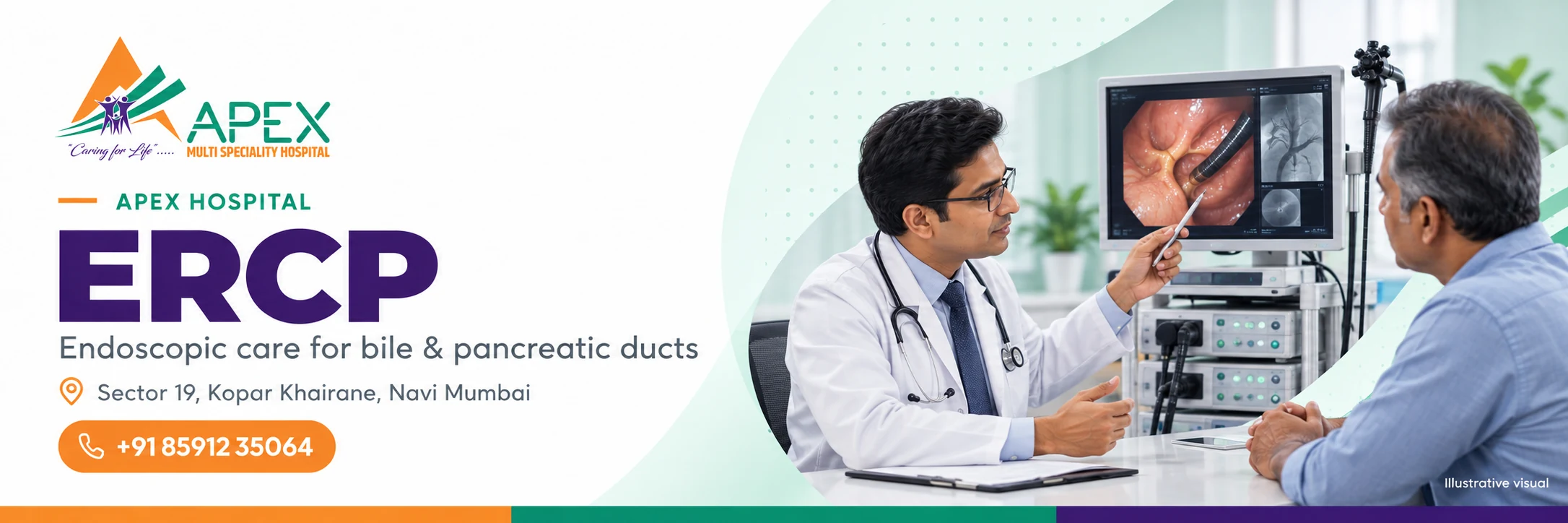
ERCP in Kopar Khairane, Navi Mumbai
ERCP (endoscopic retrograde cholangiopancreatography) is a procedure that combines endoscopy and X-rays to examine and treat the bile ducts and pancreatic duct. It is most often used to remove stones from the bile duct and to open blockages that cause jaundice. At Apex Multispeciality Hospital, Kopar Khairane, ERCP is performed by gastroenterologists under sedation. [HOSPITAL TO VERIFY: fluoroscopy (C-arm) available for ERCP]
Why is ERCP done?
- Stones in the common bile duct (CBD stones)
- Jaundice caused by a blocked bile duct
- Infection of the bile ducts (cholangitis)
- Some cases of gallstone pancreatitis
- Narrowing or blockage of the bile duct from other causes, including tumours
- Bile leaks after gallbladder surgery
What can be done during ERCP?
- Sphincterotomy: a small cut at the duct opening to help stones pass out
- Stone removal using a small balloon or basket
- Stent placement: a small tube to keep a narrowed duct open and allow bile to drain
- Brushings or biopsy to check for abnormal cells
How to prepare
- Do not eat or drink for about 6 to 8 hours before [HOSPITAL TO VERIFY: hospital instructions]
- Tell your doctor about blood thinners, allergies (especially to contrast dye or iodine) and if you could be pregnant
- Blood tests are usually done beforehand
- Arrange for someone to stay with you, as you may need to stay in hospital
What happens during ERCP
- You receive sedation and lie mostly on your front.
- An endoscope is passed through the mouth into the duodenum, where the bile duct opens.
- A thin tube is passed into the duct and contrast dye is injected so the ducts show on X-ray.
- Stones are removed or a stent placed as needed. The procedure usually takes 30 to 90 minutes.
Risks of ERCP
ERCP is more complex than a routine endoscopy. The most common complication is inflammation of the pancreas (post-ERCP pancreatitis), which is usually mild. Other risks include bleeding, infection, a tear in the bowel wall and reactions to sedation. You will be observed after the procedure, and some patients stay overnight.
ERCP and gallbladder surgery
If you have stones in both the gallbladder and the bile duct, ERCP clears the duct, and the gallbladder is usually removed by laparoscopic gallbladder surgery to prevent stones coming back.
Go to emergency now for severe or worsening tummy pain, vomiting blood or material like coffee grounds, black tarry stools, heavy bleeding from the back passage, a hard swollen tummy, or high fever with yellow eyes. Call +91 85912 35064 or 108, or come to the 24/7 Emergency department. |
Our gastroenterology team
ERCP at Apex is supported by Apex Hospital’s medical team, including:
- Dipak Ahire, MD, DNB (Gastroenterology) [HOSPITAL TO VERIFY: Services page says MBBS, MD Gastroenterology; Doctors page says MD, DNB (Gastro). Confirm exact degrees]
- Dipak Shashi Kumar, MBBS, MD (Gastroenterology) [HOSPITAL TO VERIFY: confirm super-speciality degree (DM or DNB Gastroenterology)]
Meet the team on our doctors page.
ERCP in Kopar Khairane, Navi Mumbai
Patients do not need to travel far for bile duct procedures, and surgery is available in the same hospital. Apex Multispeciality Hospital is in Sector 19, Kopar Khairane, near MSEB, and serves patients from Kopar Khairane, Ghansoli, Vashi and nearby parts of Navi Mumbai. Get directions.
Talk to our gastroenterologists about ERCP. Request an appointment or call +91 85912 35064. |
Frequently asked questions
Is ERCP a surgery?
No. ERCP is an endoscopic procedure done through the mouth, without any cut on the tummy.
How long does ERCP take?
Usually 30 to 90 minutes, depending on what needs to be done.
Will I stay in hospital after ERCP?
Some patients go home the same day. Others stay overnight for observation, especially after treatment.
What is the main risk of ERCP?
The most common risk is pancreatitis after the procedure, which is usually mild. Bleeding and infection are less common.
Do I still need gallbladder surgery after ERCP?
Often yes. If you have gallbladder stones, removing the gallbladder helps prevent more stones entering the bile duct.
Sources
- Johns Hopkins Medicine: Endoscopic Retrograde Cholangiopancreatography (ERCP)
- MedlinePlus: ERCP