Apex Multispeciality Hospital : Kopar Khairane
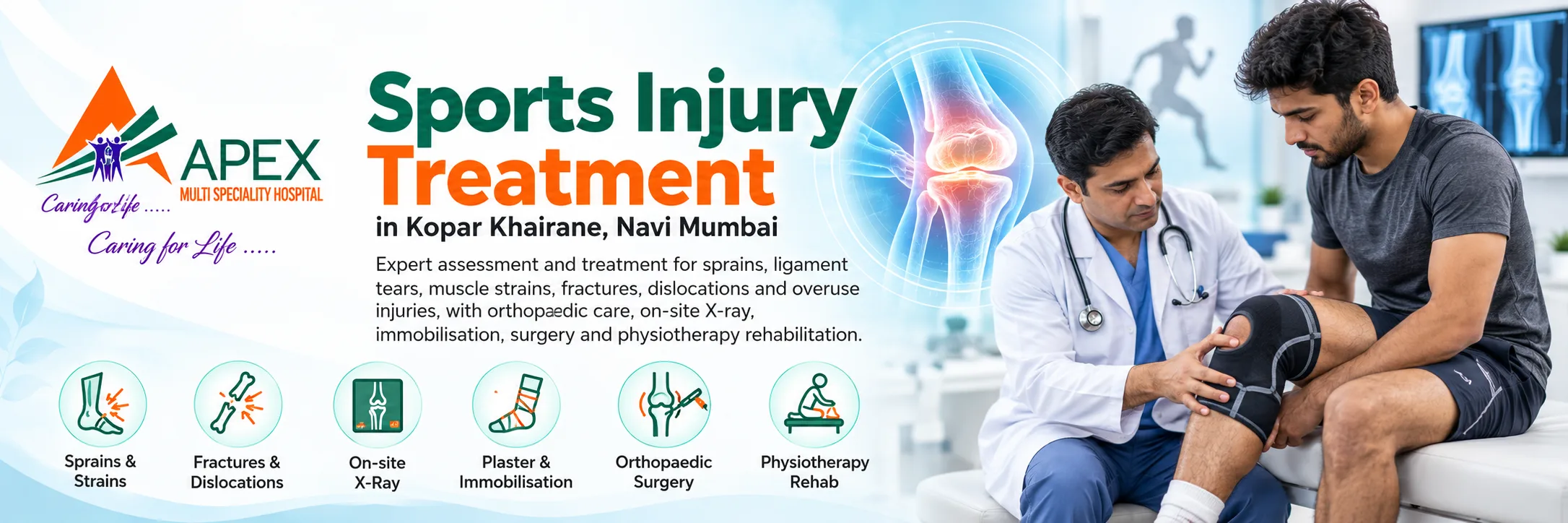
Sports Injury Treatment in Kopar Khairane, Navi Mumbai
Sports injuries — sprains, ligament tears, muscle strains, fractures, dislocations and overuse injuries — are assessed and treated at the Apex Orthopaedics department, Sector 19 Kopar Khairane. On-site X-ray, plaster and immobilisation, surgical repair for significant structural injuries, and physiotherapy rehabilitation are available. The emergency department receives acute sports injuries 24 hours a day.
Common sports injuries we treat
Injury | Typical cause | Initial management |
Ankle sprain (ATFL, CFL) | Inversion injury — “rolling” the ankle | RICE, brace, physiotherapy; surgical only for complete tears |
ACL / PCL tear (knee) | Twisting with foot planted; contact sports | Functional rehabilitation; arthroscopic reconstruction for athletes |
Meniscal tear (knee) | Twisting, squatting; degenerative with age | Physiotherapy; arthroscopic surgery if mechanical symptoms |
Shoulder dislocation | Fall on outstretched arm; overhead sports | Reduction under sedation; bracing; surgery for recurrent instability |
Rotator cuff tear | Overhead activities; fall; progressive degeneration | Physiotherapy, steroid injection; surgery for full-thickness tears |
Tennis and golfer’s elbow | Repetitive forearm motion | Physiotherapy, RICE, strap; corticosteroid or PRP injection; surgery rarely |
Shin splints (MTSS) | Overtraining, hard surfaces, inadequate footwear | Rest, load management, footwear assessment, physiotherapy |
Stress fracture | Repetitive loading without adequate recovery | Rest, activity modification, boot or cast in some locations |
Hamstring / quadriceps strain | Sprinting, sudden acceleration | RICE, graded return to training |
Patellar tendinopathy | Jumping sports; basketball, volleyball | Eccentric strengthening, load management; surgery rarely |
The PRICE protocol — what to do immediately
For most soft tissue injuries in the first 24–72 hours, the PRICE protocol reduces swelling, pain and secondary damage:
- P — Protection: stop the activity; use crutches or a brace if weight-bearing is painful
- R — Rest: relative rest from the aggravating activity, not complete bed rest
- I — Ice: 15–20 minutes every 2 hours; do not apply ice directly to skin (use a cloth)
- C — Compression: an elasticated bandage reduces swelling
- E — Elevation: keep the injured limb raised above heart level where possible
Get a proper assessment even if the injury seems minor. A “bad sprain” is sometimes a fracture, and a fracture misidentified as a sprain can heal with deformity or delayed union.
When to come immediately to the emergency department
- Obvious deformity, inability to move the limb, or a bone visible or felt under the skin
- Complete inability to bear weight after an ankle or knee injury — this needs imaging
- Significant swelling appearing within minutes of injury (haemarthrosis — blood in the joint — suggests ACL rupture or fracture)
- A popping or snapping sound at the time of injury followed by the knee “giving way”
- Shoulder dislocation — the joint looks visibly different and any attempt to move it is extremely painful
- Head, neck or spine injury in any contact sport — do not move the person; immobilise and call 108 or +91 85912 35064
The emergency department at Apex is open 24 hours. On-site X-ray is available immediately. For injuries that need MRI, imaging is arranged and the orthopaedic surgeon reviews the report.
Investigation and treatment pathway
- Clinical assessment by the orthopaedic surgeon — mechanism of injury, examination, functional testing.
- X-ray where indicated — on site, same visit. This rules out fracture before further soft-tissue investigation.
- MRI if soft-tissue detail is needed — arranged and reported, then reviewed with the surgeon.
- Treatment decision: conservative physiotherapy, immobilisation, injection, or surgical repair.
- For surgical injuries: planned admission and arthroscopy or open repair.
- Post-surgical rehabilitation: physiotherapy protocol with milestone-based return to sport.
Return to sport planning
A return-to-sport decision is not just “pain is gone.” It includes regaining strength symmetry between the injured and uninjured side, passing functional tests appropriate to the sport, and psychological readiness. Returning too early significantly increases re-injury risk. Your surgeon and physiotherapist will set specific milestones.
For complex injuries like ACL reconstruction, the timeline from surgery to return to competitive sport is typically 9–12 months for most patients, regardless of how quickly the pain resolves.
Frequently asked questions
How do I know if my ankle sprain is serious?
If you cannot bear weight, or the pain and swelling are severe, get an X-ray to exclude a fracture. Apply RICE while waiting. If the X-ray is clear and you have a moderate or severe sprain, a physiotherapy assessment is worthwhile — high-grade sprains with ligament damage have a high re-injury rate without rehabilitation.
Do I need surgery for an ACL tear?
Not always. Many people, particularly those who are not athletes or do not play pivoting sports, can function well after ACL injury with intensive physiotherapy. Surgery is most clearly indicated for athletes who want to return to pivoting or contact sport, and for knees with combined injuries (ACL plus meniscus).
How long does a sports injury take to recover?
Ankle sprains: mild — days to two weeks; severe — 6–8 weeks. Knee ACL: surgery plus rehabilitation — 9–12 months. Rotator cuff: minor tears — 4–6 weeks; surgical repair — 4–6 months. Stress fracture — 4–8 weeks. Every case is individual.
Is physiotherapy available at Apex?
Yes. Physiotherapy services are available at Apex Multispeciality Hospital, supported by qualified healthcare professionals and empanelled doctors. Patients are assessed and guided with an appropriate physiotherapy and rehabilitation plan based on their individual medical condition and recovery needs.
Can I get a PRP injection for my sports injury?
Platelet-rich plasma (PRP) injections are used for some tendon and soft tissue injuries. See the PRP for joint pain page.
Can I walk in for a sports injury assessment without an appointment?
Yes. Acute injuries are seen in the emergency department at any hour. For planned OPD orthopaedic consultations, call ahead to confirm the consultant is available.
Do I need an MRI before the first consultation?
No. Bring any X-rays or imaging you already have. The surgeon will assess you first and then order what is needed. Ordering MRI without a clinical assessment often leads to over-investigation.
Book a sports injury consultation
Call +91 85912 35064 or book an appointment online. For acute injuries, come directly to the emergency entrance — 24 hours.