Apex Multispeciality Hospital : Kopar Khairane
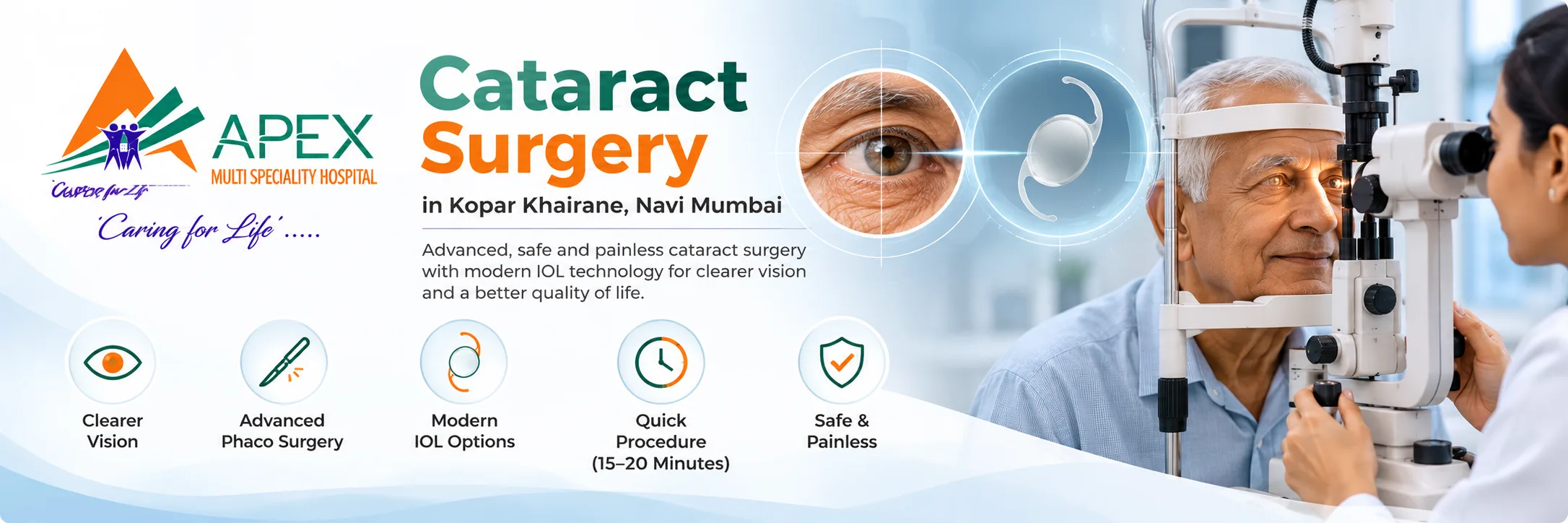
Cataract Surgery in Kopar Khairane, Navi Mumbai
Cataract surgery at Apex Multispeciality Hospital, Sector 19, Kopar Khairane is performed using modern surgical techniques such as phacoemulsification with intraocular lens implantation. In most cases, it is a day-care procedure, allowing patients to return home the same day after appropriate observation. Overnight admission is generally not required, although it may be advised in exceptional cases based on the patient’s age, medical condition, surgical requirements, or the doctor’s recommendation. The cost of cataract surgery can vary depending on the type of lens selected, surgical technique, investigations, and individual clinical requirements. For the most accurate and up-to-date quotation, patients are advised to contact Apex Hospital directly.
What is a cataract?
The natural lens of the eye sits behind the pupil and focuses light onto the retina. It is normally clear. A cataract is a clouding of this lens — most commonly caused by the natural ageing process, but also by diabetes, steroid medication, injury and congenital causes.
As the cataract develops, vision becomes increasingly hazy, blurred, or yellowed. Patients often describe difficulty reading, driving at night, glare from lights, and faded colours. Glasses cannot correct a cataract — the only effective treatment is surgery to replace the clouded lens with an artificial one.
Cataract is the leading cause of reversible blindness in India, according to the National Programme for Control of Blindness (NPCB). The good news is that with modern phacoemulsification, visual recovery is rapid and the results are highly reliable.
Phacoemulsification — the standard procedure
Phacoemulsification (phaco) uses an ultrasound probe inserted through a 2.4–2.8 mm self-sealing incision to break the clouded lens into tiny fragments, which are then removed. A rolled-up foldable intraocular lens (IOL) is inserted through the same small incision and unfolds inside the eye. No stitches are required in most cases. The eye is patched for a few hours after surgery.
The procedure takes 15–20 minutes under local (peribulbar or topical) anaesthesia. You are awake, comfortable and aware of light but will not see the surgery. You leave the same day or after a few hours of observation.
Intraocular lens (IOL) options
IOL type | Who it is for | Spectacles after surgery |
Monofocal IOL (standard) | Most patients | Usually needed for reading or distance (one or the other) |
Toric IOL | Patients with pre-existing astigmatism | Reduces spectacle dependence for distance |
Multifocal IOL | Patients wanting near and distance without glasses | Often reduces spectacle dependence significantly |
EDOF (Extended Depth of Focus) IOL | Patients wanting a range of vision with fewer halos than multifocal | Intermediate and distance; may still need reading glasses |
The right IOL for you depends on your pre-operative corneal topography, your lifestyle and visual demands, the density of the cataract, and whether any other eye disease is present. The surgeon will advise after the pre-operative assessment.
Pre-operative assessment
- Slit-lamp examination of the anterior segment
- Fundus examination this is important. Cataract surgery improves media clarity but cannot improve vision lost to retinal disease, glaucoma or macular degeneration. Setting realistic expectations requires knowing what the retina looks like before surgery.
- A-scan biometry an ultrasound measurement of the eye’s axial length used to calculate the IOL power required for your target refraction
- Corneal topography if a toric or premium IOL is being considered.
- Blood glucose if you have diabetes poorly controlled diabetes increases infection risk.
What to expect on the day of surgery
- Arrive fasting: Patients are generally advised to fast for approximately 8 hours before surgery, unless the treating doctor or anaesthetist gives different instructions based on the planned procedure, medications, or medical condition.
- Dilating eye drops are instilled. This takes 45–60 minutes. Bring sunglasses; your vision will be blurred.
- Local anaesthetic drops or injection are given. You should feel no pain.
- The procedure takes 15–20 minutes. You see light and movement but the surgical field is not visible to you.
- A protective shield covers the eye. You are discharged same day with eye drops and written instructions.
Recovery and post-operative care
Vision begins to clear within 24–48 hours for most patients. The full result takes 4–6 weeks as the eye settles. During recovery:
- Use antibiotic and anti-inflammatory eye drops exactly as prescribed — for 4–6 weeks
- Do not rub the eye
- Avoid swimming, dusty environments and heavy lifting for 2–4 weeks
- Dark glasses outdoors for the first week
- Attend all follow-up appointments — typically the day after, at one week, and at one month
If you have sudden severe pain, markedly worsening vision, or a red eye after surgery, call the hospital immediately — these can be early signs of infection (endophthalmitis) which is rare but requires urgent treatment.
Cost of cataract surgery in Navi Mumbai
The cost of cataract surgery at Apex Multispeciality Hospital starts from approximately ₹20,000 per eye and may vary depending on the type of intraocular lens (IOL) selected, surgical technique, investigations, room requirements, surgeon’s recommendation, and the patient’s individual clinical condition. Premium lens options such as toric or multifocal IOLs may involve additional costs. As cataract surgery packages and lens prices can change over time, patients are advised to contact Apex Hospital directly for the latest and most accurate quotation before planning surgery.
Cashless Insurance & TPA
Cashless cataract surgery may be available for eligible patients depending on their insurance policy, TPA, coverage limits, waiting periods, and approval terms. Coverage for premium IOLs may differ from standard lens coverage. Patients should contact the Apex Hospital insurance/TPA desk with their policy details so the team can check eligibility, guide them through the pre-authorization process, and clarify any applicable out-of-pocket expenses. Check your policy. See the insurance and TPA page.
Frequently asked questions
Is cataract surgery painful?
No. Local anaesthesia makes the procedure painless. You will feel pressure and see bright light but not pain. Some mild discomfort and a gritty sensation are normal in the first day or two after surgery.
How long does cataract surgery take?
The procedure itself takes 15–20 minutes per eye. Plan for 3–4 hours at the hospital on the day including preparation, dilating drops, surgery and recovery.
Can both eyes be done on the same day?
Generally no. The standard practice is to operate on one eye, confirm good healing and vision improvement, then operate on the second eye — usually 2–4 weeks later.
Will I need glasses after cataract surgery?
With a standard monofocal IOL, most patients need glasses either for distance or for reading (depending on the target refraction). With a toric IOL, spectacles for distance are often not needed in patients with astigmatism. Multifocal and EDOF lenses reduce overall spectacle dependence for many activities but do not eliminate it for everyone.
Is cataract surgery safe for diabetic patients?
Yes, with good blood sugar control. Diabetics do have a higher risk of post-operative infection and slower healing. Blood glucose should be well controlled before the procedure.
What is the right age for cataract surgery?
When the cataract is significantly affecting vision or quality of life — not based on age. Most patients are over 60, but cataracts develop earlier in diabetics, those on long-term steroids, or those with previous eye injury.
Can cataract come back after surgery?
The implanted IOL does not develop a cataract. However, about 20–30% of patients develop posterior capsule opacification (PCO) — a clouding of the membrane behind the IOL — months to years after surgery. This is treated with a quick, painless laser procedure (YAG capsulotomy) in the OPD, not another surgery.
Is cashless cataract surgery available at Apex?
Yes. Cashless cataract surgery is available at Apex Multispeciality Hospital for eligible patients through empanelled insurers and TPAs. Coverage depends on the individual insurance policy, applicable limits, waiting periods, and pre-authorization approval. Patients are advised to contact the hospital’s insurance/TPA desk with their policy details so the team can verify eligibility and guide them through the cashless approval process.
Book a cataract consultation
Call +91 85912 35064 or book an appointment online. Apex Multispeciality Hospital, Sector 19, near MSEB, Kopar Khairane, Navi Mumbai 400709.