
Apex Multispeciality Hospital : Kopar Khairane
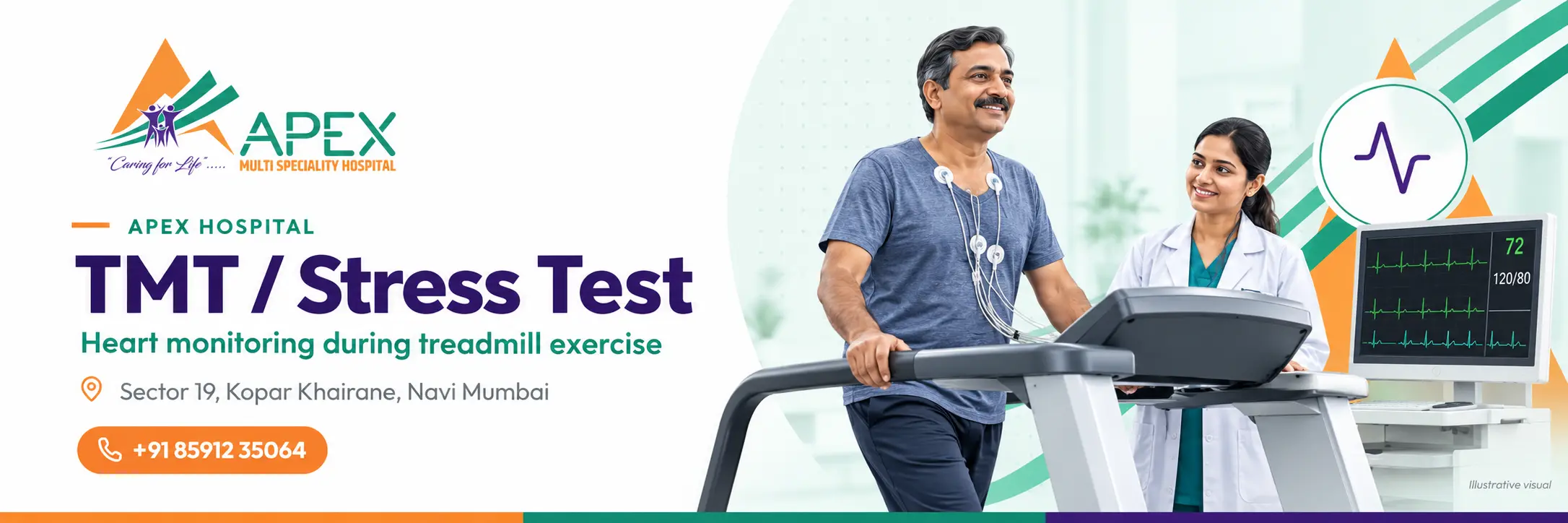
TMT (Treadmill Stress Test) in Kopar Khairane, Navi Mumbai
A treadmill test (TMT), also called an exercise stress test, measures how the heart responds to physical exertion while the patient’s ECG, heart rate, blood pressure and symptoms are monitored. It helps doctors look for reduced blood supply to the heart. Apex Multispeciality Hospital in Kopar Khairane offers TMT under the supervision of its cardiology team.
What is a TMT test?
Some heart problems only show up when the heart is working hard. During a TMT, you walk on a treadmill that gets gradually faster and steeper, usually every 3 minutes. Throughout the test, an ECG records your heart’s electrical activity and your blood pressure is checked. If an artery supplying the heart is narrowed, the ECG may change or you may feel symptoms as the heart’s demand for oxygen rises.
Why is a TMT done?
- To investigate chest pain or breathlessness on exertion
- To check for coronary artery disease in people with risk factors
- To assess how much exercise is safe after a heart problem
- To check whether heart treatment is working
- To look for rhythm problems triggered by exercise
Who should not have a TMT?
A TMT is not suitable for everyone. Your doctor will first check you and may choose another test if you have, for example, a very recent heart attack, chest pain at rest, uncontrolled high blood pressure or heart rhythm, a severely narrowed heart valve, or a condition that makes walking on a treadmill unsafe.
How to prepare for a TMT
- Wear comfortable clothes and walking or sports shoes.
- Have only a light meal 2 to 3 hours before the test. [HOSPITAL TO VERIFY: hospital’s exact food and fasting instructions]
- Avoid tea, coffee and smoking for a few hours before. [HOSPITAL TO VERIFY: hospital protocol]
- Ask your doctor about your medicines. Some heart medicines can affect the result. Do not stop any medicine on your own.
- Bring earlier ECGs, echo reports and your prescription.
What happens during the test
- Electrodes are placed on your chest and a blood pressure cuff on your arm. A resting ECG is recorded first.
- You start walking slowly. Every few minutes the speed and slope increase.
- Tell the staff at once if you feel chest pain, dizziness or severe breathlessness.
- The test stops when you reach the target heart rate, feel too tired, or if symptoms or ECG changes appear.
- You are monitored while resting for about 10 to 15 minutes afterwards.
The whole visit usually takes 45 to 60 minutes.
Understanding your TMT result
- Negative (normal): no significant ECG changes or symptoms at the level of exercise reached.
- Positive (abnormal): changes suggest the heart may not be getting enough blood during exercise.
- Inconclusive: the test could not give a clear answer, for example if the target heart rate was not reached.
A TMT is a screening test, not a final diagnosis. A positive result may lead to a 2D echo, a stress echo or coronary angiography. Your cardiologist will explain the next step.
Is a TMT safe? Risks and limitations
For most people, a TMT is as safe as a brisk uphill walk. Rarely, it can trigger chest pain, an irregular heartbeat, a drop in blood pressure or a fall. The test is supervised by trained staff with a defibrillator and emergency medicines at hand.
No test is perfect. A TMT can sometimes show changes when the arteries are normal, or miss disease, especially in some women and in people whose resting ECG is already abnormal.
Can't walk on a treadmill? Dobutamine stress echo
If knee pain, weakness or another condition stops you exercising, a dobutamine stress echo may be used. A medicine called dobutamine is given through a drip to make the heart work harder while a 2D echo checks how the heart muscle responds. [HOSPITAL TO VERIFY: dobutamine stress echo is performed in-house. If not, replace with ‘your cardiologist will advise an alternative test’]
Who supervises your TMT?
Your TMT is supported by Apex Hospital’s cardiology team, including:
- Dhammdeep Humane, MD, DM (Cardiology)
- Rakesh Trimale, MD, DM (Cardiology)
Tests are carried out by trained cardiac technicians and reported by the cardiology team. [HOSPITAL TO VERIFY: who performs and who reports each test] Meet the team on our doctors page.
TMT test in Kopar Khairane, Navi Mumbai
Apex Multispeciality Hospital offers TMT in Sector 19, Kopar Khairane, near MSEB. Patients from Kopar Khairane, Ghansoli, Vashi and nearby areas can complete a TMT, ECG and 2D echo in one hospital. Get directions.
Book a TMT test. Call +91 85912 35064 or request an appointment. Bring your prescription and wear walking shoes. |
Frequently asked questions
Is TMT the same as a stress test?
Yes. TMT (treadmill test) is the most common type of exercise stress test. It checks how your heart responds to exercise while your ECG and blood pressure are monitored.
How long does a TMT test take?
The walking part usually lasts 6 to 12 minutes. With preparation and recovery monitoring, plan for 45 to 60 minutes.
Should I eat before a TMT?
Have only a light meal 2 to 3 hours before the test, unless the hospital gives you different instructions.
Should I stop my heart medicines before a TMT?
Only if your doctor tells you to. Some medicines can affect the result, but never stop them on your own.
What does a positive TMT mean?
It suggests the heart may not get enough blood during exercise. It is not a final diagnosis. Your cardiologist may advise a stress echo or angiography.
What is the cost of a TMT at Apex Hospital?
Please call +91 85912 35064 for the current price. [HOSPITAL TO VERIFY: add TMT price in Rs if the hospital agrees]
Sources
- MedlinePlus (US National Library of Medicine): Exercise stress test
- American Heart Association: Exercise stress test
- MedlinePlus: Stress echocardiography