
Apex Multispeciality Hospital : Kopar Khairane
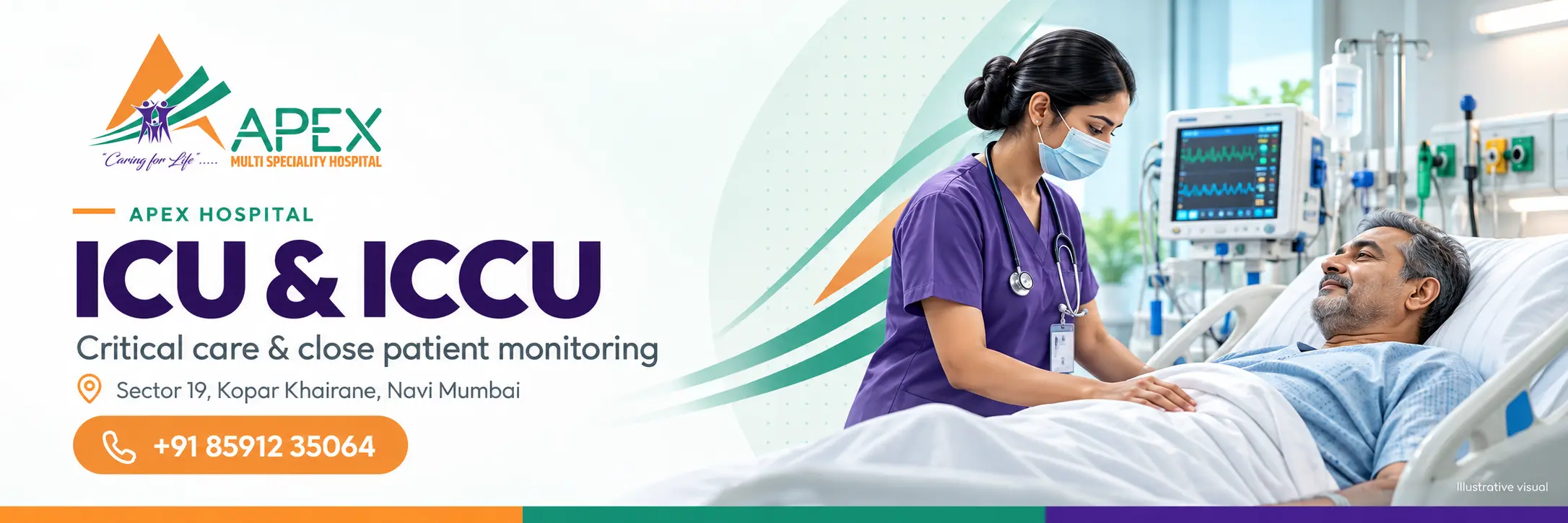
ICU & ICCU Critical Care in Kopar Khairane, Navi Mumbai
Apex Multispeciality Hospital in Kopar Khairane has an intensive care unit (ICU) and intensive cardiac care (ICCU) for adults who are critically ill and need round-the-clock monitoring and life support. The unit has ventilators, BiPAP machines, cardiac monitors, defibrillators and a central oxygen supply, with qualified doctors and nurses present 24 hours a day.
What is the difference between an ICU and an ICCU?
An ICU (intensive care unit) looks after patients whose life is at risk from any serious illness, such as severe infection, breathing failure or poisoning.
An ICCU (intensive cardiac care unit) focuses on serious heart problems, such as a heart attack, a dangerous heart rhythm or severe heart failure. These patients need continuous heart monitoring and quick access to a cardiologist.
Who may need intensive care?
- A heart attack, including monitoring after thrombolysis (clot-dissolving treatment)
- Severe heart failure or a dangerous heart rhythm
- Severe breathing difficulty, including pneumonia, flare-ups of COPD or asthma, and ARDS
- Sepsis, a life-threatening reaction to infection
- Poisoning or drug overdose
- Stroke, brain bleeds and serious head injury
- Serious road accidents and other trauma
- Diabetic emergencies and severe dengue
- Close monitoring after a major operation
ICU facilities and equipment
- Ventilators and BiPAP machines for breathing support
- Multi-parameter cardiac monitors at every bed
- Defibrillators for life-threatening heart rhythms
- Syringe pumps for precise delivery of medicines
- Central oxygen supply
- Qualified doctors and nursing staff on duty 24×7
- 24×7 electricity backup
ARDS and severe breathing failure
Acute respiratory distress syndrome (ARDS) is a serious condition in which the lungs become inflamed and fill with fluid, so oxygen cannot reach the blood properly. It can follow pneumonia, sepsis, injury and other illnesses. Patients with ARDS are treated in the ICU with oxygen, BiPAP or ventilator support, treatment of the underlying cause and careful fluid management, with input from our chest physicians.
How care is organised in our ICU
- Patients come to the ICU from the emergency department, the wards or the operation theatre.
- Continuous monitoring. Heart rate, blood pressure, oxygen level and breathing are watched all the time.
- Daily specialist review. Physicians, cardiologists, chest physicians and surgeons see patients according to their condition.
- Step-down. When stable, patients move to the ward to continue recovery.
Information for families
- The treating doctor meets the family to explain the patient’s condition and plan. [HOSPITAL TO VERIFY: fixed time for daily family briefing]
- Visits are limited to protect patients from infection. [HOSPITAL TO VERIFY: ICU visiting hours and attendant policy]
- You will be asked for consent before major procedures such as putting a patient on a ventilator.
- For cashless treatment, share the patient’s policy details at the front desk early. See our insurance and TPA list.
Risks and limitations of intensive care
Intensive care gives the best possible support, but it cannot guarantee recovery. Seriously ill patients can develop complications such as new infections, blood clots, confusion (delirium) and muscle weakness, and the ICU team works to prevent and treat these.
If a patient needs a treatment that is not available at Apex, such as heart surgery or specialised paediatric intensive care, the team arranges a safe transfer to a suitable hospital.
If someone is critically ill right now, bring them to the Apex emergency department or call +91 85912 35064. For an ambulance in Maharashtra, dial 108. |
Our critical care team
Patients in the ICU and ICCU are cared for by Apex Hospital’s medical team, including:
- Anish Thakur, MD (Emergency Physician) [HOSPITAL TO VERIFY: homepage says MD Medicine, Doctors page says MD Emergency Physician. Confirm the exact degree]
- Dhammdeep Humane, MD, DM (Cardiology)
- Rakesh Trimale, MD, DM (Cardiology)
- Prem Mourya, MD (Chest Physician)
- Manas Bhanushali, MD (Chest Physician)
with other specialists from our doctors page involved as needed.
ICU and ICCU in Kopar Khairane, Navi Mumbai
The ICU and ICCU are inside Apex Multispeciality Hospital, Sector 19, Kopar Khairane, near MSEB. Being close by matters in critical illness: families from Kopar Khairane, Ghansoli, Vashi and nearby areas can reach the hospital quickly, and patients can move from the emergency department to intensive care in the same building. Open in Google Maps.
Need an ICU bed or want to speak to the team? Call +91 85912 35064. For planned admissions, contact the hospital. |
Frequently asked questions
Does Apex Hospital have an ICU with a ventilator?
Yes. The ICU at Apex Multispeciality Hospital, Kopar Khairane, has ventilators, BiPAP machines, cardiac monitors, defibrillators and a central oxygen supply.
What is an ICCU?
An ICCU is an intensive cardiac care unit for patients with serious heart problems such as a heart attack, dangerous heart rhythms or severe heart failure, who need continuous heart monitoring.
Are doctors available in the ICU at night?
Yes. Qualified doctors and nursing staff are on duty in the ICU 24 hours a day, 7 days a week.
Can family members stay with an ICU patient?
Visits are limited to protect patients from infection. The team will explain visiting times and meet the family to give updates.
Is cashless insurance accepted for ICU admission?
Apex works with several insurance and TPA companies. Share policy details at the front desk as early as possible so pre-authorisation can start.
Does Apex have a paediatric ICU?
No. Apex does not have a paediatric intensive care unit (PICU). If a child needs intensive care, the team stabilises the child and arranges transfer to a hospital with a PICU.
Sources
- NHS: Intensive care